

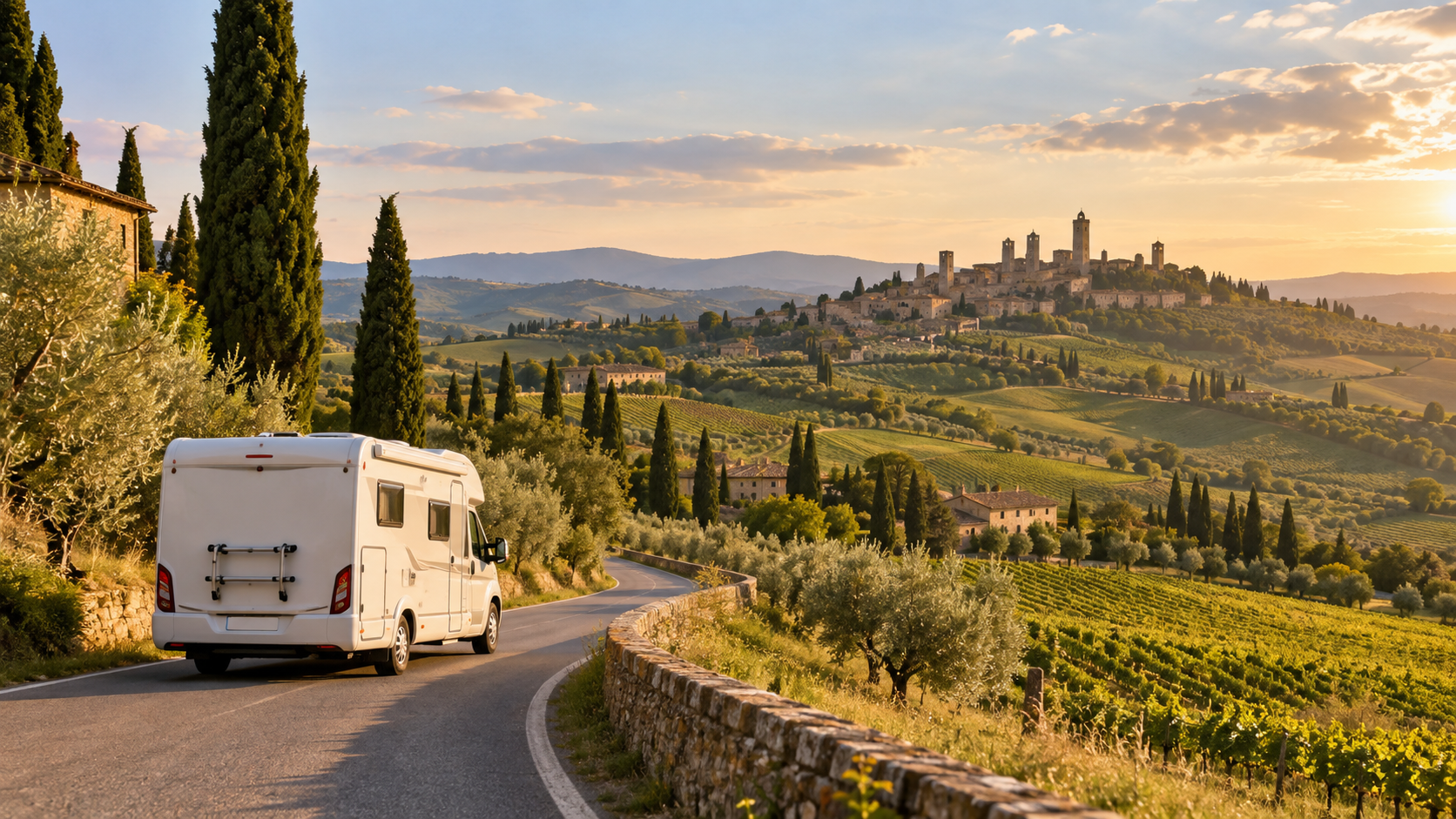
 Traveling through Italy by RV gives you something that trains and organized tours cannot always provide: the freedom to stop in small villages, explore remote coastlines and wake up near mountains, vineyards or olive groves.
In Italy, an RV or motorhome is normally called a camper. You may also encounter the terms campervan, motorcaravan and autocaravan. Although camper travel is well established throughout the country, driving and overnight parking require more planning than they often do in the United States.
Narrow roads, historic centers, toll highways and restricted traffic zones can create difficulties for an oversized vehicle. Choose the right camper, understand the rules and plan overnight stops before leaving, however, and Italy becomes an extraordinary destination for a road trip.
This guide explains what international visitors should know about renting, driving, parking and traveling by RV in Italy.
Why Explore Italy by RV?
Italy combines famous cities with enormous areas of countryside that are difficult to explore by public transportation.
Trains make it easy to travel between Rome, Florence, Venice, Milan, Naples and other major cities. They are less useful when you want to visit isolated beaches, mountain villages, national parks, rural wineries or archaeological sites far from railway stations.
A camper allows you to experience more of Italy’s regional diversity:
- Drive through the Dolomites and the Alpine valleys of northern Italy.
- Follow the vineyards and medieval towns of Tuscany.
- Explore the mountains and Adriatic coastline of Abruzzo.
- Travel between masserie, beaches and whitewashed villages in Puglia.
- Discover the national parks of Calabria.
- Reach rural areas of Sicily and Sardinia.
- Stop near lakes, farms, hiking trails and lesser-known ฟุตบอล villages.
Camper travel is particularly rewarding for visitors who want to go beyond the familiar tourist itinerary and experience Italian culture at a slower pace.
However, an RV is not always the cheapest option. Rental fees, fuel, tolls, campsite charges and insurance can add up quickly. Its greatest advantage is independence rather than guaranteed savings.
RV, Motorhome or Campervan: What Should You Rent?
American travelers may be surprised by the relatively compact size of many European motorhomes.
Smaller vehicles are generally better suited to Italy because they are easier to maneuver through villages, mountain roads, campsites and crowded parking areas. They also consume less fuel and are less likely to encounter height, width or weight restrictions.
Campervan
A campervan is usually the easiest option for two travelers. It offers greater maneuverability and may fit into parking spaces that cannot accommodate a full-size motorhome.
The disadvantages are limited storage, reduced living space and, in some models, a very small bathroom or no bathroom at all.
Compact motorhome
A compact motorhome offers a useful compromise between comfort and size. It normally includes a kitchen, bathroom, dining space and fixed or convertible sleeping areas.
This is often the best choice for couples or small families planning a multiweek journey.
Large motorhome
A large motorhome provides more space but can be difficult to drive in Italy. Historic towns, coastal roads, mountain passes and older campgrounds may have narrow entrances or limited turning areas.
Unless you need the additional beds, storage or accessibility features, avoid renting a vehicle larger than necessary.
Caravan or travel trailer
A caravan can work well for travelers staying several nights at each campground. You can leave the caravan at the campsite and use the towing vehicle for local excursions.
It is less convenient for an itinerary that involves frequent stops, narrow roads or regular movement between cities.
Documents Required to Drive a Camper in Italy
Requirements depend on your nationality, licence and the country in which the vehicle is registered.
You should normally carry:
- A valid driving licence
- Your passport or recognized identity document
- The camper’s registration documents
- Proof of insurance
- Rental agreement, when applicable
- Emergency and roadside-assistance information
Travelers holding a licence issued outside the European Union may also need an International Driving Permit or an official translation. Requirements can differ according to the licence’s country of origin, so confirm them with the rental company before arriving.
Italy’s official tourism website provides an updated overview of the documents and requirements for driving in Italy.
Also check the camper’s maximum authorized weight. A standard passenger-car licence may not cover heavier motorhomes, depending on the licence category and applicable regulations.
Driving an RV on Italian Roads
Driving a compact camper on modern highways is generally straightforward. The situation changes once you leave the main roads.
Village streets may be extremely narrow. Historic gateways can have width or height restrictions, while mountain and coastal roads may include sharp bends, steep gradients and limited visibility.
Before following a navigation app, confirm that the suggested road is suitable for your vehicle. A route that works perfectly for a small car may be inappropriate for a motorhome.
Useful driving precautions
- Enter the camper’s height, width, length and weight into an RV-compatible navigation system.
- Avoid unverified shortcuts through historic towns.
- Watch for low bridges, overhanging balconies and narrow tunnels.
- Allow additional braking distance, especially on downhill roads.
- Use lower gears on long descents rather than relying continuously on the brakes.
- Check mirrors carefully when passing buses or trucks.
- Refuel before traveling through remote mountain or rural areas.
- Never assume a roadside parking space is long or wide enough for the entire vehicle.
For additional planning advice, see Italia Mia’s guide to the best driving routes in Italy.
Understanding Italy’s ZTL Zones
A Zona a Traffico Limitato, generally identified by the initials ZTL, is a restricted traffic area. ZTLs are particularly common in historic city centers.
Entrances are often monitored by cameras that record licence plates. Driving through an active ZTL without authorization can result in a fine, even if you entered accidentally or followed your navigation system.
Motorhomes are especially unsuitable for the centers of cities such as Florence, Rome, Bologna and Siena. The safest strategy is to park at a campground or designated camper area outside the center and continue by train, tram or bus.
Remember that:
- ZTL operating hours vary by municipality.
- Restrictions can change by season, day or time.
- Some zones have additional emissions requirements.
- Permission from a hotel does not automatically guarantee access.
- Rental companies may charge an administrative fee in addition to the municipal fine.
Do not drive past a ZTL sign unless you have confirmed that the restriction is inactive or that your vehicle has been authorized.
Motorway Tolls and Fuel Costs
Most major Italian motorways, known as autostrade, charge tolls. The total usually depends on the route traveled and the vehicle’s classification.
A camper may be charged differently from a passenger car because toll categories can take axle count and vehicle height into consideration.
When entering a toll motorway, take a ticket unless you are using an electronic toll lane. Present the ticket when leaving and pay the displayed amount.
Avoid lanes reserved exclusively for electronic toll devices unless your rental camper includes a compatible device. Card and cash-payment lanes are usually clearly marked.
Italia Mia’s guide to Italian autostrade explains the main routes, toll system and differences between toll and toll-free highways.
Fuel in Italy is generally more expensive than in the United States. A large motorhome can therefore make a long north-to-south itinerary costly. Compare the vehicle’s fuel consumption before booking and calculate the approximate distance of your planned route.
Where Can You Park an RV in Italy?
Camper parking in Italy falls into several broad categories.
Campgrounds
A traditional campground, or campeggio, is the most comfortable option for a longer stay. Facilities may include:
- Electrical connections
- Fresh water
- Toilets and showers
- Wastewater disposal
- Laundry facilities
- Restaurants or small shops
- Swimming pools
- Beach or lake access
The ACSI campsite directory for Italy is one of the existing resources for locating campgrounds and checking available facilities.
Campgrounds near major cities are particularly useful because you can leave the camper securely parked and use public transportation to reach the historic center.
Aree di sosta camper
An area di sosta camper is a designated motorhome parking area. Facilities vary significantly.
A basic area may provide only marked parking spaces. Better-equipped locations can offer electricity, drinking water, wastewater disposal, toilets and security.
These areas are often less expensive and more convenient than full-service campgrounds, especially for one-night stops.
Useful search terms include:
- Area sosta camper
- Area attrezzata camper
- Camper service
- Parcheggio camper
Always read the signs at the entrance. Maximum stays, payment procedures and permitted activities may vary.
Agricampeggi
An agricampeggio is a camping area connected to a farm or agriturismo. These stops can be among the most memorable parts of an Italian RV journey.
Depending on the property, travelers may be able to buy local wine, olive oil, cheese, vegetables or other regional products. Some farms also offer meals, tastings or guided visits.
Facilities range from simple rural pitches to organized sites with electricity, showers and swimming pools.
Ordinary parking spaces
Italian law distinguishes between parking a motorhome and using it as a campsite.
Where motorhome parking is legally permitted, remaining inside the vehicle does not necessarily constitute camping. However, activities that extend beyond the vehicle—such as opening an awning, placing chairs outside, using stabilizers or setting up a barbecue—may cause the stop to be treated as camping.
Municipal restrictions and posted signs remain decisive. Coastal towns, national parks and heavily visited destinations may impose stricter rules.
When in doubt, use an official campground or designated camper area.
Can You Wild Camp in Italy?
Wild camping should not be treated as automatically permitted throughout Italy.
Rules and enforcement can vary by municipality, region and protected area. Beachfronts, nature reserves, national parks and popular tourist zones frequently prohibit overnight camping outside authorized areas.
Parking quietly is not the same as establishing a campsite. Extending an awning, putting tables and chairs outside, discharging water or occupying space beyond the vehicle can turn a legal parking stop into unauthorized camping.
Never empty grey or black water onto the ground or into ordinary street drains. Use a designated camper-service facility.
If you want a peaceful rural experience, a recognized agricampeggio or authorized farm stop is safer and more respectful than attempting to camp on public or private land without permission.
Visiting Italian Cities by Camper
An RV is excellent for traveling between regions but inconvenient inside major cities.
A practical approach is to choose a campground or camper area near a railway station or public-transport line. Leave the vehicle there and enter the city without worrying about ZTL cameras, garages or narrow streets.
This strategy works particularly well for:
- Florence
- Rome
- Bologna
- Verona
- Milan
- Naples
- Pisa
- Siena
- Venice and the Venetian mainland
Never attempt to drive into Venice itself. Park on the mainland or at an appropriate campsite and continue by public transportation.
For Florence, Siena and other Tuscan destinations, Italia Mia’s complete guide to Tuscany can help you decide which towns and landscapes to include.
The Best Italian Regions for an RV Trip
The Dolomites and Northern Lakes
Northern Italy is ideal for mountain scenery, hiking and organized campgrounds. Roads are generally well maintained, but gradients and tight mountain passes require careful driving.
Reserve campsites in advance during the busiest summer weeks.
Tuscany
A camper gives you access to vineyards, rural valleys and hill towns that are more difficult to reach by train.
Avoid driving through historic centers. Park outside towns such as Siena, San Gimignano, Volterra and Montepulciano, then continue on foot or by shuttle.
Read the Region of Tuscany travel guide before planning your route.
Abruzzo
Abruzzo is exceptionally suitable for camper travel because it combines mountains, national parks, villages and the Adriatic coast.
The region offers a quieter alternative to Tuscany while still providing dramatic scenery and traditional food. Start with Italia Mia’s complete guide to Abruzzo.
Puglia
A camper is useful for exploring the Gargano Peninsula, Valle d’Itria and the coastal landscapes of Salento.
Summer temperatures can be intense, and popular seaside areas become crowded in July and August. Reserve overnight stops and confirm that your camper has reliable ventilation or air conditioning.
Italia Mia’s guide to the Region of Puglia provides ideas for towns, beaches and countryside stops.
Calabria
Calabria rewards travelers willing to explore beyond its main roads. The mountains, Ionian coast and Tyrrhenian villages offer spectacular scenery, although some local roads are narrow and demanding.
The official Italian tourism website publishes several suggested camper itineraries through Calabria.
Sicily and Sardinia
Both islands offer excellent camper possibilities, particularly outside the busiest summer months.
Remember to include ferry prices when calculating your budget. Some ferry companies require accurate vehicle dimensions during booking, including bicycle racks or external storage boxes.
When Is the Best Time for an RV Trip in Italy?
Late spring and early autumn are generally the most comfortable periods for a camper journey.
April to June
The countryside is green, temperatures are usually manageable and most campgrounds are open. Mountain routes at higher elevations may still be affected by snow early in the season.
July and August
This is the busiest and hottest period. Coastal campgrounds can sell out, traffic increases and overnight prices may rise considerably.
August is especially busy around the Ferragosto holiday period.
September and October
These months are excellent for vineyards, food festivals and less crowded coastal destinations. Some seasonal campgrounds begin closing in autumn, so check availability carefully.
Winter
Winter camper travel is possible, particularly in cities, ski areas and southern regions. Confirm that campsites remain open and that the vehicle has appropriate heating, insulation and winter equipment.
Planning Your Route
Do not attempt to see the entire country in one short trip.
Italy may appear compact on a map, but slower roads, mountains, traffic and sightseeing stops make daily travel more time-consuming than expected.
A comfortable itinerary usually combines:
- Shorter driving days
- Two or more nights at important stops
- Campsites reserved near major cities
- Flexible rural or coastal sections
- Time for laundry, water refilling and waste disposal
- Alternative routes for unsuitable roads or severe weather
For a first journey, consider concentrating on one or two neighboring regions rather than driving from the Alps to Sicily.
Italia Mia’s Italy road-trip guide offers additional ideas for balancing famous destinations with less-visited places.
What to Check Before Accepting a Rental Camper
Inspect the vehicle carefully before leaving the rental location.
Check:
- Existing exterior damage
- Tire condition
- Headlights and indicators
- Mirrors and reversing camera
- Brakes and warning lights
- Gas supply and shutoff valve
- Freshwater and wastewater systems
- Electrical connection
- Refrigerator
- Heating and air conditioning
- Toilet operation
- Awning
- Levelling equipment
- Emergency triangle and reflective vest
- Spare wheel or puncture-repair kit
Photograph the camper inside and outside before departure. Ask the rental company to demonstrate every system, including how to refill water, empty waste tanks and connect electricity.
Clarify whether the rental price includes:
- Unlimited or restricted mileage
- Roadside assistance
- Additional drivers
- Bedding and towels
- Kitchen equipment
- Outdoor furniture
- Cleaning charges
- Insurance deductible
- Cross-border travel
- Ferry travel
- Winter equipment
Essential Camper Etiquette
Responsible behavior protects the places you came to enjoy.
- Dispose of wastewater only at authorized facilities.
- Never leave rubbish beside a parking area.
- Observe quiet hours.
- Do not occupy neighboring spaces with furniture.
- Keep pets controlled where required.
- Buy something when staying at a participating farm.
- Avoid generators near other campers during the evening.
- Respect fire restrictions and barbecue rules.
- Leave natural areas exactly as you found them.
A well-managed camper journey should support local communities rather than create additional pressure on them.
When a Hotel Break Improves an RV Journey
Even dedicated camper travelers sometimes appreciate a proper bed, a long shower or a central location for one or two nights. A hotel stay can also be useful before collecting your camper, after returning it or when visiting a city where driving and parking are particularly difficult.
Search Expedia hotels throughout Italy to compare accommodation for a break during your journey.
Affiliate disclosure: Italia Mia may receive a commission from qualifying reservations made through this link, at no additional cost to you.
Is Traveling by RV in Italy Worth It?
Traveling by RV is one of the most flexible ways to explore rural and regional Italy, but it requires realistic expectations.
A camper is ideal for national parks, coastlines, mountain areas, small villages and countryside itineraries. It is far less practical for entering historic centers or moving rapidly between Italy’s largest cities.
Choose a compact vehicle, avoid ZTL zones, use authorized overnight areas and plan a route with reasonable driving distances. With those precautions, a camper can take you far beyond the standard tourist circuit—into vineyards, fishing villages, mountain valleys and landscapes that many visitors never see.
Italy is not merely a collection of famous cities. Traveling by camper makes the journey between those destinations an important part of the experience.
Buon viaggio!
Related Italia Mia Articles
- Guide to Camping in Italy
- The Best Driving Routes in Italy
- Italian Autostrade Guide
- Tips for an Unforgettable Road Trip in Italy
- Italy Travel Guide
- Region of Tuscany
- Region of Abruzzo
- Region of Puglia
External Links
- Official guide to driving in Italy — Italia.it
- Italian road rules and safety — European Union
- Official camper itineraries in Italy — Italia.it
- Campsites in Italy — ACSI Eurocampings