

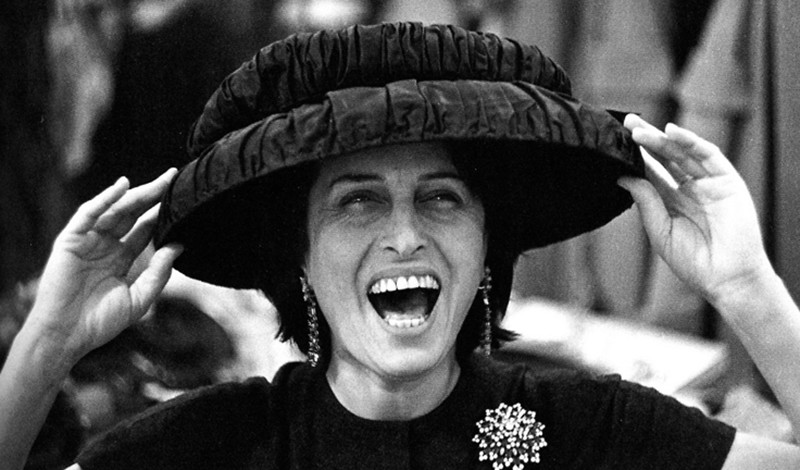
Anna Magnani was one of the most powerful and original performers in cinema history. With her expressive face, unmistakable Roman voice and refusal to hide behind conventional glamour, she brought working-class women, mothers, widows and outsiders to the screen with an emotional honesty audiences had rarely witnessed.
Internationally associated with Italian neorealism, Magnani was far more versatile than the label suggests. She excelled in revue, comedy and serious theatre before becoming a film star. She worked with directors including Roberto Rossellini, Luchino Visconti, Jean Renoir, Pier Paolo Pasolini and Sidney Lumet—and became the first Italian actress to win an Academy Award.
Early Life in Rome
Anna Magnani was born in Rome on March 7, 1908. Her mother, Marina Magnani, was a seamstress originally from Fano, while the identity of her father was never officially established. Her mother moved to Alexandria, Egypt, leaving Anna in the care of her maternal grandmother.
Contrary to accounts that describe Magnani as growing up in a Roman slum, she spent much of her childhood in her grandmother’s home on Via di San Teodoro, between the Capitoline and Palatine hills. She was surrounded by five aunts, an uncle and a grandmother whom she remembered with deep affection. Nevertheless, the prolonged absence of her mother left an emotional wound that remained important throughout her life.
Magnani attended school until the second year of high school and then enrolled at Rome’s Santa Cecilia Conservatory to study piano. In 1926, she transferred to the Eleonora Duse Royal School of Acting, where her teachers included the influential theatre critic and educator Silvio D’Amico.
Her talent was quickly noticed. Before completing her training, she was hired by the Niccodemi–Vergani–Cimara theatre company and began appearing in works by playwrights such as Gabriele D’Annunzio, W. Somerset Maugham and Georges Feydeau.
Theatre, Revue and the Making of “Nannarella”
Magnani’s screen image became so powerful that it sometimes obscured the extent of her theatrical training. During the 1930s, she moved easily between dramatic plays, musical comedy, cabaret and rivista, the popular Italian form of theatrical revue.
Her performances combined formal training with spontaneity, comic timing and a distinctively Roman manner of speaking. She did not fit the traditional image of the elegant, decorative soubrette. Instead, she created something more personal: direct, ironic, sensual, vulnerable and defiantly natural.
Her partnership with Totò in the early 1940s made her one of the leading stars of Italian revue. Onstage, the Neapolitan comedian and the Roman actress developed an energetic chemistry that allowed Magnani to refine the mixture of humour, anger and tenderness that would later define her greatest film roles.
Romans affectionately called her “Nannarella.” The nickname expressed a sense of familiarity, but Magnani was never merely a local personality. The emotional precision beneath her apparent spontaneity was the product of considerable technique and years of theatrical experience.
Marriage, Motherhood and Early Film Roles
Magnani began appearing in films during the 1930s, although her earliest roles were small. In 1935, she married director Goffredo Alessandrini, for whom she appeared in Cavalleria. The marriage eventually broke down, and they separated without Magnani marrying again.
Her first genuinely substantial film opportunity came in Vittorio De Sica’s Teresa Venerdì in 1941. As the lively entertainer Loletta Prima, she displayed a vitality that distinguished her from the polished stars of the Fascist-era “white telephone” comedies. Readers interested in the filmmaker can learn more in Italia Mia’s biography of Vittorio De Sica.
Luchino Visconti wanted Magnani for the central role in Ossessione, his groundbreaking 1943 adaptation of The Postman Always Rings Twice. Production delays and Magnani’s advancing pregnancy made her participation impossible, and the role went to Clara Calamai.
On October 29, 1942, Magnani gave birth to her only child, Luca, whose father was actor Massimo Serato. Luca contracted polio while still very young. Magnani devoted herself to his upbringing and financial security, raising him largely on her own. Her experience as a fiercely protective mother inevitably added another dimension to the maternal characters she later portrayed, although it would be reductive to explain her performances solely through her private life.
During the same period, films such as Campo de’ Fiori and L’ultima carrozzella paired her with Aldo Fabrizi and established her as a gifted interpreter of popular Roman life.
Rome, Open City and an International Breakthrough
Magnani’s transformation from a celebrated Italian performer into an international symbol came with Roberto Rossellini’s Roma città aperta, released internationally as Rome, Open City, in 1945.
Made in the immediate aftermath of Rome’s liberation, the film follows resistance members, civilians and a Catholic priest during the Nazi occupation. Film stock was scarce, studios were unavailable and parts of the city still carried the physical and psychological damage of war. These difficult production conditions contributed to the immediacy that made the film a foundational work of Italian neorealism.
Magnani plays Pina, a widowed, pregnant Roman woman preparing to marry the resistance fighter Francesco. She is humorous, impatient, exhausted and courageous—a recognisable human being rather than an idealised heroine.
When German soldiers arrest Francesco, Pina runs after the truck carrying him away and is shot in the street. The scene is sudden and brutally unsentimental. Magnani’s body falling onto the pavement became one of the defining images of postwar cinema.
Pina appears in only part of the film, yet Magnani became its emotional centre. She seemed to embody the suffering, anger and resilience of ordinary Italians emerging from Fascism, occupation and war.
Rome, Open City won the Grand Prix at the first Cannes Film Festival in 1946 and introduced both Rossellini and Magnani to a worldwide audience. It also helped establish Italian neorealism as one of the most influential movements in cinema history.
Anna Magnani and Roberto Rossellini
Magnani’s relationship with Rossellini was both artistic and romantic. Their collaboration helped shape the public identity of Italian neorealism, but it was also marked by two strong personalities and considerable emotional instability.
They worked together again on L’amore in 1948. The film consists of two episodes built around Magnani. In The Human Voice, adapted from Jean Cocteau’s play, she portrays a woman speaking on the telephone with a lover who is leaving her. Almost alone on screen, Magnani moves between hope, humiliation, silence and despair.
In the second episode, The Miracle, written by Federico Fellini, she plays an isolated woman who believes the child she is carrying has been divinely conceived. The performance combines spiritual conviction with the suffering of a person mocked and rejected by her community.
The relationship ended after Rossellini began his celebrated and controversial partnership with Ingrid Bergman. Rossellini cast Bergman in Stromboli, a role Magnani had expected might be hers.
Magnani responded by accepting the leading role in William Dieterle’s Vulcano. The two productions were filmed at roughly the same time in the Aeolian Islands, encouraging the international press to present them as a personal and professional contest between the two actresses.
The episode caused Magnani considerable pain, but her connection with Rossellini was never entirely erased. Their work together had changed both their careers, and Rossellini returned to her side during her final illness.
Bellissima and The Golden Coach
Luchino Visconti finally directed Magnani in Bellissima in 1951. She plays Maddalena Cecconi, a working-class mother determined to turn her young daughter into a film star.
Maddalena is overbearing and frequently comic, but Magnani gradually reveals the desperation beneath her ambitions. She wants her daughter to escape the limitations of their ordinary life, yet her determination draws them into an industry prepared to exploit both of them.
When Maddalena discovers that filmmakers are laughing at her daughter’s screen test, her dreams collapse. Magnani transforms the scene from social comedy into a painful recognition of how easily the entertainment industry can exploit hope and innocence.
In Jean Renoir’s The Golden Coach in 1952, Magnani demonstrated a different aspect of her talent. Playing Camilla, the leading performer in a commedia dell’arte troupe in colonial Peru, she moves between the artificial world of theatre and the conflicting demands of three admirers.
The film allowed her to explore performance itself: where an actress ends, where a character begins and whether the stage can offer a freedom unavailable in ordinary life.
Hollywood, Tennessee Williams and The Rose Tattoo
American playwright Tennessee Williams admired Magnani and wrote the role of Serafina Delle Rose in The Rose Tattoo with her in mind. Magnani declined to appear in the original Broadway production because she did not yet feel confident performing in English every night.
She eventually accepted the role in Daniel Mann’s 1955 film adaptation, opposite Burt Lancaster. It was her first Hollywood-produced film and her first English-speaking role.
Serafina is a Sicilian widow living in the American South. Following her husband’s death, she retreats into grief and idealises their marriage, only to discover that he may have been unfaithful.
Magnani makes Serafina excessive, proud, comic, sensual and deeply wounded—sometimes within the same scene. Rather than smoothing out her Italian accent and mannerisms, the production made them central to the character.
On March 21, 1956, Magnani won the Academy Award for Best Actress. She did not attend the ceremony, reportedly doubting that she would win. Her victory made her the first Italian actress to receive an Oscar.
The award confirmed that a performer who resisted Hollywood’s conventional standards of beauty could become an international star through talent, personality and emotional truth.
Wild Is the Wind and The Fugitive Kind
Magnani returned to American cinema in George Cukor’s Wild Is the Wind in 1957. She plays Gioia, an Italian woman who travels to Nevada to marry her late sister’s widower, portrayed by Anthony Quinn.
Gioia soon discovers that her husband expects her to reproduce the domestic presence of the woman he has lost. Magnani’s performance explores the loneliness of migration and the indignity of being valued as a substitute for another person.
The role earned her a second Academy Award nomination and the Silver Bear for Best Actress at the Berlin International Film Festival.
In 1960, she appeared opposite Marlon Brando in Sidney Lumet’s The Fugitive Kind, adapted from Tennessee Williams’s play Orpheus Descending. Magnani plays Lady Torrance, a frustrated shopkeeper trapped in a loveless marriage in the American South. Her encounter with Brando’s drifting musician awakens both desire and the possibility of rebellion.
The production was difficult, and Magnani felt uncomfortable with aspects of Hollywood filmmaking and with performing in English. After completing the film, she concentrated increasingly on European projects.
Yet her American period proved that her acting style could transcend language and national borders without losing its unmistakably Italian identity.
Mamma Roma and the Later Years
Magnani gave one of her last great performances in Pier Paolo Pasolini’s Mamma Roma in 1962. She plays a former sex worker attempting to build a respectable life for herself and her teenage son, Ettore.
Mamma Roma’s ambition is touching but also tragically compromised. She believes that a home, a market stall and the right acquaintances can protect her son from the poverty and marginalisation that shaped her own life. Pasolini, however, presents a society in which respectable appearances cannot overcome entrenched inequality.
The role connected Magnani once again with the streets and working-class characters associated with neorealism. Yet she had become frustrated by being repeatedly cast as a loud, suffering woman of the Roman poor. Her dissatisfaction reflected her awareness that her abilities were broader than the roles producers commonly offered her.
For more about the film’s director, see Italia Mia’s biography of Pier Paolo Pasolini.
Magnani later returned to the stage, appearing in productions including Giovanni Verga’s La lupa and Jean Anouilh’s Médée. She also starred in television films directed by Alfredo Giannetti, demonstrating that her intimate acting style was particularly effective on the smaller screen.
Her last major international film was Stanley Kramer’s The Secret of Santa Vittoria in 1969. However, this was not her final screen appearance.
That came in Federico Fellini’s Roma in 1972. Fellini encounters Magnani outside her home at night and addresses her as a symbol of Rome itself. She smiles, exchanges a few words with him and closes the door—a brief but fitting cinematic farewell.
Italia Mia’s biography of Federico Fellini provides more context on the director and his lifelong fascination with the Italian capital.
Death and Enduring Influence
Anna Magnani died in Rome on September 26, 1973, at the age of 65. She had been receiving treatment for pancreatic cancer. Large crowds gathered for her funeral, demonstrating the exceptional affection Italians—and Romans in particular—felt for her.
Magnani changed the way women could appear on screen. She did not ask the camera to idealise her. Fatigue, age, laughter, jealousy, desire and anger were visible in her face and body.
Yet the impression of complete spontaneity should not disguise her technical discipline. She knew precisely how to use movement, silence, dialect and sudden changes in emotional rhythm. Her apparently uncontrolled emotional explosions were supported by decades of theatrical experience.
Her characters were rarely passive victims. Even when defeated by war, poverty, betrayal or social prejudice, they argued, resisted, loved and demanded to be recognised. Magnani gave working-class women an individuality that prevented them from becoming picturesque symbols.
She also helped international audiences understand that Italian cinema extended beyond glamorous stars and postcard landscapes. Her performances connected private emotion with the historical experiences of wartime occupation, reconstruction, migration and social change.
Retrospectives, restorations and critical studies continue to introduce her work to younger audiences. Among the great figures discussed in Italia Mia’s guide to 100 years of Italian cinema, Magnani remains unique: unmistakably Roman, deeply Italian and universally human.
Essential Anna Magnani Films
Rome, Open City (1945)
The resistance drama that made Magnani an international symbol of Italian neorealism.
L’Amore (1948)
Two demanding performances that demonstrate her ability to command the screen almost alone.
Bellissima (1951)
A moving and frequently funny portrait of maternal ambition and the illusions created by Cinecittà.
The Golden Coach (1952)
Jean Renoir’s colourful meditation on theatre, identity, love and artistic freedom.
The Rose Tattoo (1955)
Magnani’s first English-language role and the performance that earned her the Academy Award for Best Actress.
Wild Is the Wind (1957)
An intense drama of migration, marriage and emotional displacement that brought Magnani a second Oscar nomination.
The Fugitive Kind (1960)
Magnani and Marlon Brando star in Sidney Lumet’s adaptation of Tennessee Williams’s Orpheus Descending.
Mamma Roma (1962)
Pasolini’s tragic portrait of a mother trying to secure a better future for her son.
Watch Anna Magnani’s Films
DVD, Blu-ray and streaming availability varies by country, but many of Magnani’s major films remain available in restored editions.
Browse Anna Magnani films on Amazon.com
Find Rome, Open City on Amazon.com
External Links
Anna Magnani – Dizionario Biografico degli Italiani, Treccani
Anna Magnani’s 1956 Academy Award – Oscars.org
How Anna Magnani Became the Face of Italian Neorealism – British Film Institute
Rome, Open City – The Criterion Collection
Mamma Roma – The Criterion Collection